




I. Foreword: The Evolution from "Copper" to "Fiber"
In the realm of network connectivity, Ethernet cables and optical fibers are like two parallel technological paths, each carrying different missions. Ethernet cables (twisted pair) dominate short-distance communication with their low cost and ease of deployment, while optical fibers, with their high bandwidth and anti-interference advantages, are at the core of long-distance transmission. With the development of 5G, cloud computing, and industrial internet, making the optimal choice between the two has become key to enterprise and home network planning. This article will provide decision-making guidance through technical comparisons and scenario analysis.
II. Technical Comparison of Ethernet Cables and Optical Fibers
1. Performance Differences: Limitations of Copper Cables and Breakthroughs of Optical Fibers
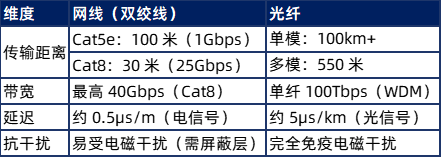
Typical Applications:
- Ethernet Cables: Home router to PC (Cat6a), data center server to TOR switch (Cat8).
- Optical Fibers: Inter-city backbone networks (single-mode), high-speed interconnections within data centers (multi-mode OM5).
2. Installation and Cost: The Game Between Short-Term Investment and Long-Term Gains
- Ethernet Cable Advantages:
Plug-and-play, no need for professional fusion splicing equipment, short construction period.
Low cost: Cat6a patch cable approximately 10 yuan/meter, fiber MPO patch cable approximately 100 yuan/meter.
- Optical Fiber Challenges:
Requires fusion splicer (cost 100,000+ yuan) and optical power meter, high construction complexity.
High cost of optical modules: Single-mode 100G LR4 module approximately 2000 yuan, multi-mode SR4 approximately 500 yuan.
3. Anti-Interference Capability: The Lifeline in Industrial Scenarios
- Ethernet Cables: In strong electromagnetic environments like factories and hospitals, shielded twisted pair (STP) can reduce interference, but high-frequency signal attenuation is significant (e.g., Cat6a only supports 55 meters at 10Gbps).
- Optical Fibers: Quartz material insulation, no signal crosstalk, suitable for scenarios with extremely high stability requirements such as CNC machine tools and medical imaging equipment.
III. Hybrid Networking: A Practical Solution Balancing Performance and Economy
1. Division of Labor for Backbone and Access Layers
- Core Layer: Adopts single-mode fiber + Wavelength Division Multiplexing (WDM) to achieve cross-regional 10 Gigabit interconnections.
- Aggregation Layer: Multi-mode fiber connects building clusters, supporting 40G/100G short-distance transmission.
- Access Layer: Ethernet cables cover terminal devices, e.g., Cat6a supports 10Gbps to the desktop.
Case: An enterprise campus connects three office buildings via single-mode fiber, with OM4 multi-mode fiber used within the buildings to floor switches, finally connecting workstations via Cat6a Ethernet cables.
2. Optimization for Cost-Sensitive Scenarios
- Home Network: After fiber-to-the-home, use Ethernet cables to connect routers and smart devices (e.g., IPTV, NAS), reducing cost by 60%.
- Small and Medium-sized Enterprises: Use fiber for the backbone (e.g., OM3) and Cat6a for branches, achieving Gigabit to the desktop within budget.
3. Compatibility Design for Future Evolution
- Ethernet Cables: Cat8 supports 25G/40G, reserving space for upgrades in the next 5 years.
- Optical Fibers: OM5 multi-mode fiber supports SWDM technology, allowing smooth transition to 400G, protecting investment.
IV. Summary: Three Major Rules for Media Selection
- Distance Rule:
≤100 meters: Prioritize Ethernet cables (Cat6a/Cat8).
100 meters to 550 meters: Multi-mode optical fiber (OM4/OM5).
>550 meters: Single-mode optical fiber (G.652/G.657).
- Bandwidth Rule:
Below 1Gbps: Cat5e/6.
10Gbps: Cat6a/OM3 optical fiber.
Above 25Gbps: Cat8/OM4 optical fiber.
- Environmental Rule:
Severe electromagnetic interference: Optical fiber or shielded twisted pair (STP).
High-density deployment: Optical fiber MPO patch cables (saves 80% space).
V. Future Trends: Fiber Advances, Copper Coexists
- Optical Fiber Popularization: 50G PON technology is driving Fiber-to-the-Room (FTTR); home Gigabit coverage is expected to increase from 35% in 2023 to 60% in 2025.
- Ethernet Cable Innovation: Cat8.1 standard supports 25Gbps@100 meters, expanding short-distance high-speed scenarios.
- Converged Architecture: Optical fiber handles the "main arteries," while Ethernet cables cover the "capillaries," jointly building an efficient network ecosystem.
In the wave of digital transformation, Ethernet cables and optical fibers are not either-or choices, but rather complementary and symbiotic partners. By scientifically planning hybrid networking solutions, one can enjoy the high bandwidth and reliability of optical fiber while leveraging the economy and flexibility of Ethernet cables, ultimately achieving an optimal balance between network performance and cost.